

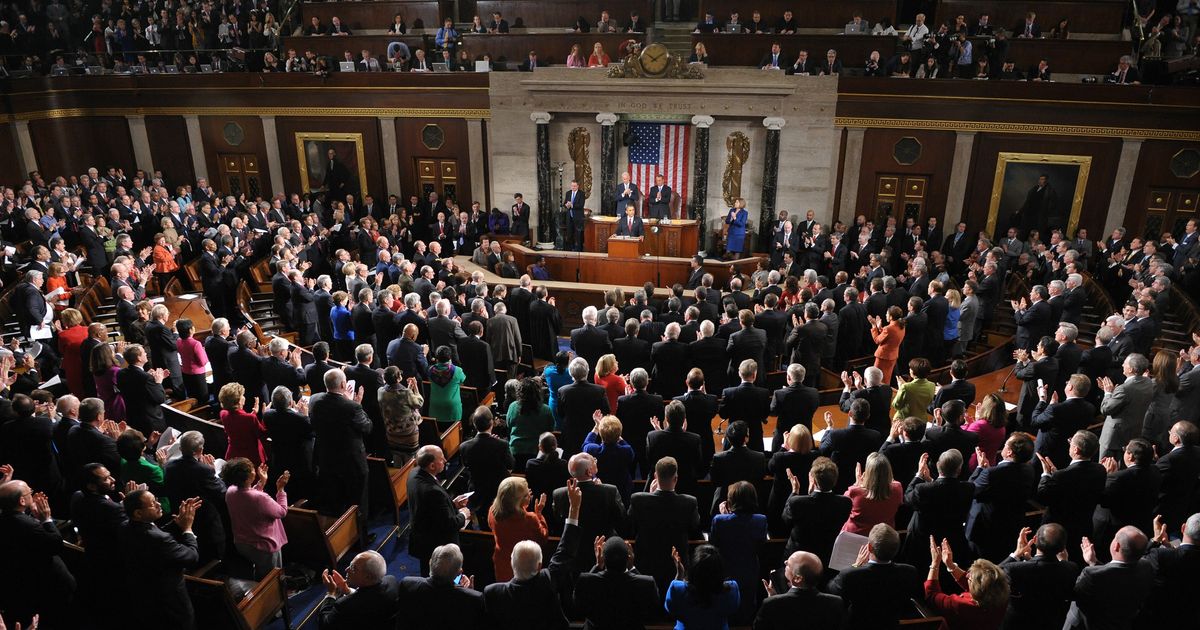
U.S. President Donald Trump delivered the longest State of the Union address in American history on Tuesday (February 24, 2026), speaking for 1 hour and 41 minutes as he attempted to reassure the nation amid economic concerns and declining approval ratings.
The address, delivered in the House Chamber of the United States Capitol, comes just months before the crucial 2026 mid-term elections.
Democratic Congressman removed for protest
Before the speech began, Al Green was escorted out of the chamber after raising a protest sign criticizing the administration.
Security officials removed him shortly before the President entered, marking one of the most visible disruptions seen at a State of the Union in recent years.
Trump touts economic and foreign policy achievements
During the lengthy address, President Trump declared that “we’re winning so much,” highlighting what he described as:
- A renewed manufacturing boom
- Strong job creation “across all sectors”
- A newly assertive U.S. posture on the world stage
He argued that his administration has “rebuilt American strength” and established “a new world order based on American leadership, fairness, and power.”
The comments come at a time when financial markets have shown signs of volatility, and Americans have expressed concern about inflation, borrowing costs, and investment uncertainty.
Record-breaking duration
Trump’s 1 hour and 41 minutes surpassed the previous modern-era record held by Bill Clinton, whose 1995 State of the Union lasted 1 hour and 20 minutes.
A pitch to voters ahead of mid-terms
The President used the nationally televised speech to cast himself as the only leader capable of navigating economic challenges, saying his policies had created “historic prosperity” and strengthened America’s standing abroad.
With Republican candidates defending control of the House and Senate, the address functioned not only as a policy speech but as a campaign message aimed at energizing voters and calming concerns about economic slowdowns.
Democrats push back
Democratic leaders dismissed the speech as “political theater,” accusing the President of overstating accomplishments while downplaying economic anxieties felt by ordinary Americans.
Several Democrats also criticized the removal of Representative Al Green, saying peaceful protest “should not be treated as disorder.”