

Archaeologists in southern Turkey have unearthed five remarkably preserved loaves of bread dating to the Byzantine era, including one with a Greek inscription and an image of Jesus Christ.
The latest discovery in the modern day Topraktepe in Karaman’s Ermenek District, offers a new insight into the spiritual and cultural life of early Christian Antolia.
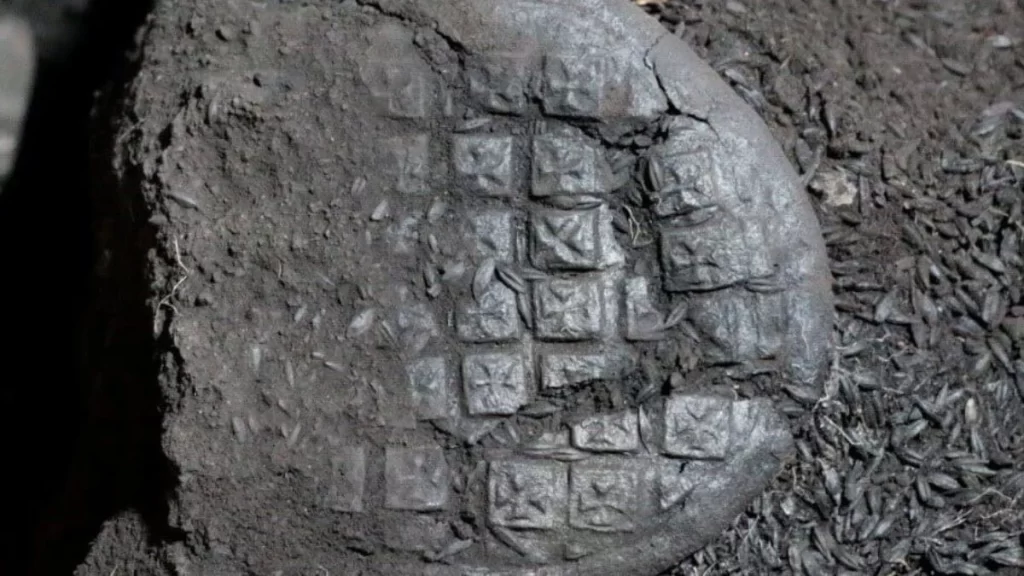
The loaves dates back to 7th or 8th century AD, was found in a carbonized state. According to experts, the loaves survived more than a millennium thanks to the rare preservation conditions that kept their shapes and surface details intact.
One of the bread bears an inscription translated in English as, “With our gratitude to the Blessed Jesus,” alongside an image of Christ. Epigraphic specialists have confirmed the translation and suggest that the phrase most likely signifies an expression of gratitude or a form of prayer.
The use of Greek language portrays the region’s strong connection to Hellenic-Christian traditions that shaped the early Byzantine society.
The figure in the bread shows Jesus as a sower unlike the familiar Byzantine depiction of Christ Almighty. Archaeologists argue that this interpretation reflects the spiritual significance of labor and fertility in the era’s theology.
The image references back to the parable of Sower, symbolizing faith spreading like seeds and connecting divine grace with human effort.
Other loaves found at the site feature cross imprints, indicating they may have been used as Eucharistic bread in early Christian Communion practices.
Such markings, according to experts reflect Greek Orthodox liturgical traditions where leavened bread was baked with sacred inscriptions or symbols before being offered during divine liturgy.
Described by officials as one of the most remarkable discoveries in recent years, the find highlights the lasting presence of the Greek language and Orthodox symbolism deep within Anatolia. The Byzantine-era bread, bearing a Greek inscription, offers a physical connection to the faith of ancient communities and underscores the enduring cultural heritage of the Greek-speaking Byzantine world.