

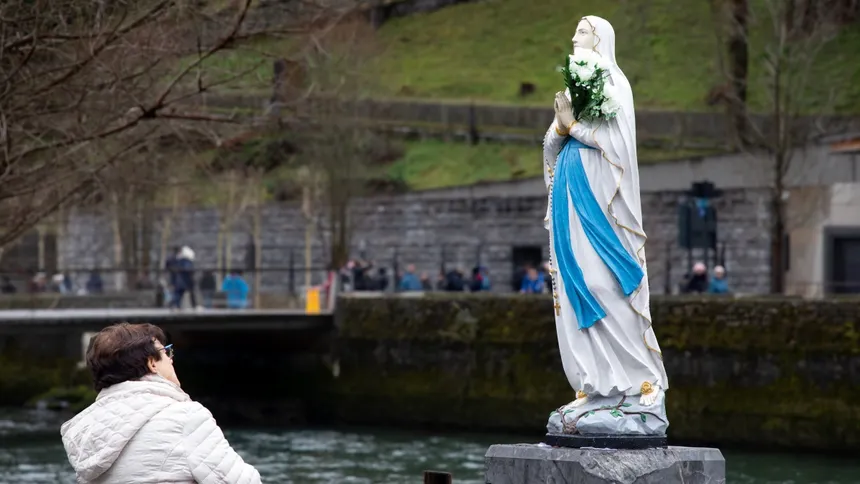
For believers across the world, the name Lourdes carries a resonance that extends beyond geography. Located in southern France, Lourdes has become one of the most revered Marian pilgrimage destinations, drawing millions who seek prayer, healing and hope. More than a shrine, it is widely regarded as a place where the presence of the Blessed Virgin Mary continues to be felt through events that challenge human explanation.
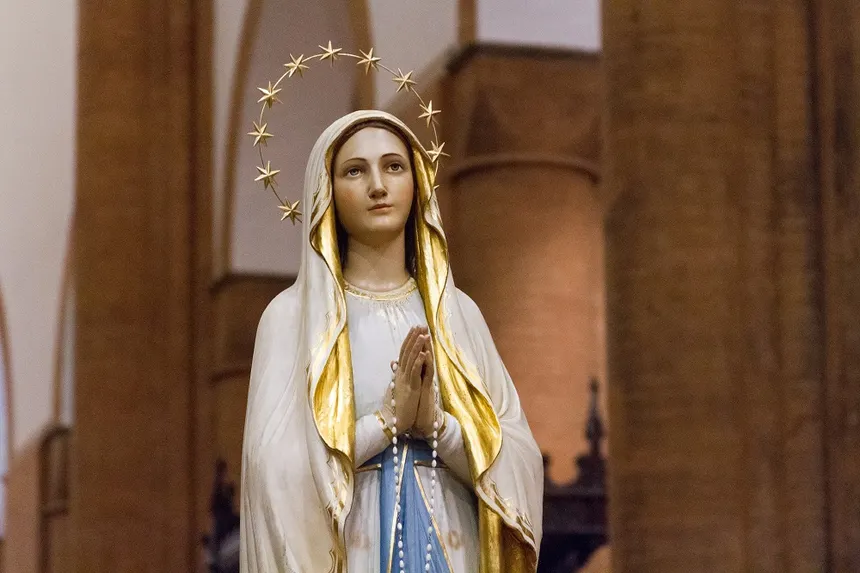
The origins of Lourdes date back to 11 February 1858, when Bernadette Soubirous, a 14-year-old girl from an impoverished family, reported an apparition of the Virgin Mary at the Massabielle Grotto. Bernadette described the apparition as a young woman dressed in white, wearing a blue sash and veil, and holding a golden rosary. Over time, 18 apparitions were reported. The Roman Catholic Church officially recognised the apparitions of Our Lady of Lourdes on 18 January 1862.
It was during the ninth apparition that Mary instructed Bernadette to dig into the earth, revealing a spring of water. Just days later, Louis Bourriette, who was blind, washed his eyes with the water and regained his sight. The account spread rapidly, prompting an influx of the sick and suffering to Lourdes. Today, the shrine receives approximately six million pilgrims each year from around the globe.
Reports of extraordinary healings soon prompted closer scrutiny. In 1905, Pope Pius X directed that all alleged miracles be formally recorded and subjected to scientific investigation. This led to the establishment of the Lourdes International Medical Committee, a panel of about 30 experts, including surgeons and professors. While more than 7,000 healings have been reported, only 72 have received official recognition by the Catholic Church.
The most recent recognition was announced on 16 April 2025, coinciding with the feast of St Bernadette. The proclamation was made by Fr Michael Daubanes, Rector of the Sanctuary of Lourdes, following the rosary prayer. The 72nd recognised miracle concerned Antonietta Raco, an Italian woman who suffered from sclerosis, a progressive condition causing severe muscle weakness and paralysis. Her recovery occurred during a pilgrimage to Lourdes in 2009, after bathing in the spring. Following years of medical examination, the healing was declared scientifically inexplicable.
This declaration came just four months after the confirmation of the 71st miracle, involving John Jack Traynor, a British soldier gravely wounded during World War I. Injured in 1914 and again in 1915, Traynor’s condition deteriorated despite multiple surgeries. By 1923, doctors concluded that no medical treatment could save him, and he was granted a full military pension due to total disability. He later joined the Archdiocese of Liverpool’s first pilgrimage to Lourdes, despite severe opposition from family and clergy who feared for his life.
During a six-day stay in Lourdes, Traynor bathed repeatedly in the spring. On the fourth day, while immersed in the water, a Eucharistic procession passed nearby, dedicated especially to the sick. At that moment, Traynor sensed a return of strength in his paralysed right arm and believed he could walk. Initially dismissed as imagination, his recovery became undeniable the following morning when he rose from bed, knelt to pray the rosary, and walked unaided to the Grotto. Extensive medical evaluations later failed to provide any explanation. Traynor died on 8 December 1943.
Lourdes has also been the setting for remarkable spiritual conversions. One of the most significant involved Alexis Carrel, a French physician and 1912 Nobel Prize laureate. Born in 1873 into a Catholic family, Carrel abandoned religious belief during his college years and became an outspoken atheist. He dismissed the Lourdes healings as psychological phenomena and travelled there with a doctor friend to disprove them.
During the journey, Carrel encountered Marie Bailly, a young woman suffering from tuberculous peritonitis, who was in a semi-conscious state. Carrel believed she would die before reaching Lourdes or shortly after arrival. However, upon reaching the shrine, Bailly was taken near the Grotto, where water from the spring was poured over her abdomen three times. Within minutes, her swollen abdomen returned to normal, her pulse stabilised, and by evening she was eating normally. Carrel witnessed the transformation firsthand.
Fearful of professional ridicule, Carrel initially denied that anything extraordinary had occurred, even mocking believers in public statements. He later moved to Canada and then to the United States, joining the Rockefeller Institute for Medical Research in New York. Meanwhile, Marie Bailly entered religious life. Internally troubled by what he had witnessed, Carrel eventually acknowledged the event as an encounter with divine presence. In 1939, he renewed contact with a Catholic priest, and three years later publicly affirmed belief in God, the immortality of the soul, divine revelation, and the teachings of the Catholic Church. He died in 1944, at peace, though without receiving the final sacraments.
Today, Lourdes stands as the world’s foremost Marian pilgrimage centre, where Eucharistic processions and rosary processions take place daily, drawing pilgrims from across the globe. At the heart of this enduring spiritual legacy is Bernadette Soubirous, the young girl through whom the miraculous history of Lourdes began. She later entered religious life, taking the name Sister Marie Bernadette. Despite chronic illness and the repeated administration of the last rites, she refused to return to Lourdes for healing, insisting that the miracles were meant for others. She died on 16 April 1879 and was canonised by Pope Pius XI on 8 December 1933. Her incorrupt body remains preserved to this day.
The Feast of Our Lady of Lourdes, celebrated annually on 11 February, is also observed as the World Day of the Sick. This designation was made by Pope John Paul II on 13 May 1992. Each year, Eucharistic processions and rosary prayers continue at Lourdes, as pilgrims entrust the sick and suffering of the world to the intercession of the Virgin Mary.