

In a deeply personal moment of pilgrimage, Pope Leo XIV visited the ancient city of Hippo on Tuesday, travelling from Algiers to Annaba — the modern name for the city where St. Augustine served as bishop for more than three decades. For the Augustinian pontiff, the journey was nothing less than a homecoming to the very foundations of his faith and religious vocation.
St. Augustine served as Bishop of Hippo from 396 to 430, and it was there that he died at around age 75 while the city was under siege by the Vandals. His remains were later moved to protect them from desecration — first to Cagliari, and then to Pavia — and his relics now rest in the Basilica of San Pietro in Ciel d’Oro, which Pope Leo is scheduled to visit later this year.
Among the surviving Roman-era remains at the archaeological site are a paved forum with columned porticoes, a theatre, a market, baths, cisterns, and figurative mosaics. Christian-era elements also survive, including the Basilica Pacis, where Augustine carried out his episcopal ministry, and its adjoining baptistery.
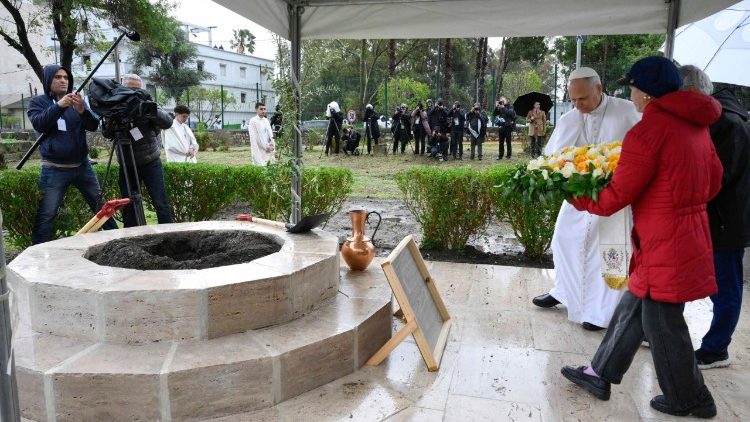
Despite driving rain that cut the visit shorter than planned, Pope Leo walked through the ruins and, at the end of the route, laid a wreath of flowers. The choir of the Annaba Institute of Music then performed pieces in Latin, Berber, and Arabic — drawing on texts by St. Augustine centred on peace and fraternity. The Holy Father concluded with a brief prayer before departing.
The visit stands as a powerful symbol of continuity — a pope formed by Augustine’s charism returning to the sacred ground where that charism was first lived out, reminding the Church that its roots run deep, and its witness endures across the centuries.