

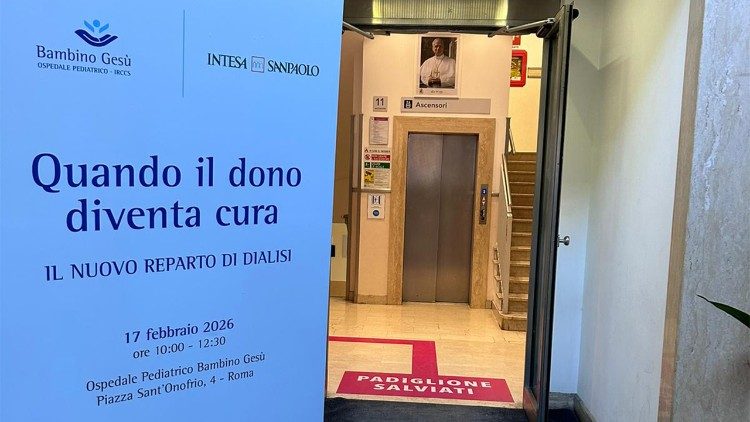
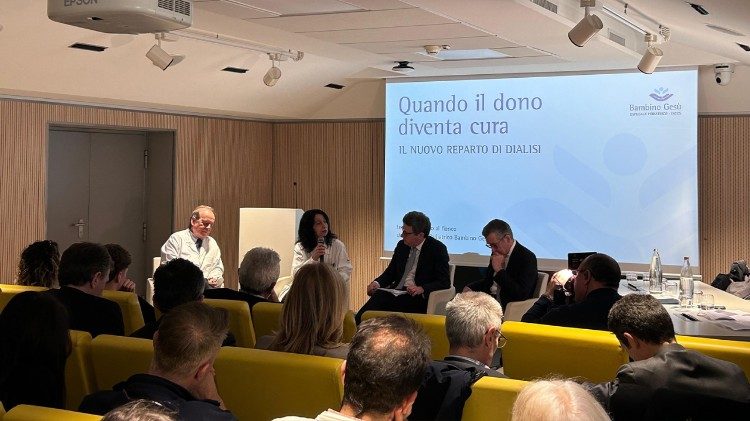
Rome — Organ donation is a gesture of love that “transcends death,” said Cardinal Pietro Parolin during a visit to Rome’s Bambino Gesù Pediatric Hospital, where he inaugurated a newly renovated dialysis unit and addressed a conference titled “The Culture of Giving.”
Speaking in the Salviati Hall at the hospital’s Janiculum Hill site on February 17, the Vatican Secretary of State reflected on generosity in a world increasingly measured by “profit, performance and utility.”
“What can we give?” he asked. “In fact, we can give everything.”
Giving Beyond Profit
Cardinal Parolin outlined three essential forms of giving: financial support, organ donation and time.
Money, often seen as the least spiritual form of charity, can become a “tool of justice” when inspired by love, he said. Economic generosity, he added, restores dignity and makes future care possible.
He thanked donors who contributed to the renovation of the dialysis department, including Italian banking group Intesa Sanpaolo, describing their contributions as participation in a “mission of care and hope.”
“We must trust in God,” he said, “but He works through human beings.”
“A Love That Does Not Surrender to Death”
Turning to organ donation, the Cardinal described it as one of the most profound expressions of Christian charity — especially in hospital wards where children await life-saving transplants.
Citing the Gospel phrase, “No one has greater love than this, to lay down one’s life for one’s friends,” he said that in the pain of loss, parents who consent to donate a child’s organs generate “life, hope and a future” for others.
“Human life is relationship and communion; in a donated body there beats a love that does not surrender to death,” he said.
The theme resonated deeply at Bambino Gesù, where dialysis patients often await kidney transplants.
The Gift of Time
Cardinal Parolin also emphasized a form of giving accessible to everyone: time.
In what he described as today’s “frenzied world,” listening, accompanying and simply remaining at someone’s side becomes one of the highest forms of charity.
He praised volunteers, doctors and nurses, noting that healthcare is not merely a profession but a vocation requiring both technical skill and humanity.
“The quality of a civilization is measured by its ability to care for the weakest,” he said.
A Young Patient’s Story
Among those who spoke at the event was 17-year-old transplant recipient Samuele Galimberti. After years of peritoneal dialysis and hemodialysis that kept him in hospital through much of his adolescence, he received a kidney transplant that transformed his life.
He later grew 30 centimeters, regained strength and, last August in Germany, became world champion in the 5,000 meters at the World Transplant Games.
“Every evening I pray twice — once to God and once for my donor, who is my guardian angel,” he said. “He saved my life.”
The event concluded with hospital leaders reaffirming their commitment to investing in children’s health and challenging what they called a prevailing “culture of profit.”
For Cardinal Parolin, the message was clear: every act of generosity becomes “providence passing through human hands” — a reminder that giving, in all its forms, sustains both faith and humanity.