

A new Pew Research Center report released on Feb. 12, 2026, analyzes religious diversity across 201 countries and territories, revealing where populations are most — and least — evenly distributed across major faith groups.
The report shows that while the United States is not among the world’s top 10 most religiously diverse nations overall, it ranks first among the world’s most populous countries (those with at least 120 million people).
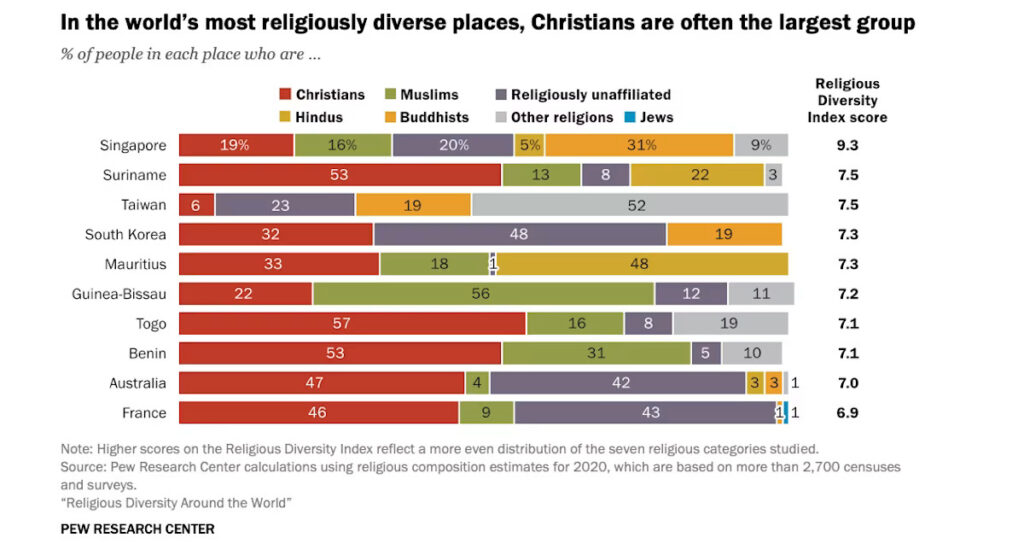
Globally, Singapore remains the most religiously diverse country.
How Pew Measures Religious Diversity
The study, Religious Diversity Around the World, uses Pew’s Religious Diversity Index (RDI), which measures how evenly populations are distributed across seven groups:
- Christians
- Muslims
- Hindus
- Buddhists
- Jews
- All other religions
- Religiously unaffiliated
The 201 countries included account for 99.98% of the world’s population.
Overall, Pew found that global religious diversity has remained relatively stable from 2010 to 2020.
Most Religiously Diverse Countries
Singapore is the most religiously diverse country, with:
- Buddhists: 31%
- Unaffiliated: 20%
- Christians: 19%
- Muslims: 16%
- Hindus: 5%
- Other religions: 9%
Half of the world’s top 10 most diverse nations have Christian majorities, including:
- Suriname
- South Korea
- Mauritius
- Guinea-Bissau
- Togo
- Benin
- Australia
- France
- Taiwan
France is the only European country in the top 10, with nearly equal shares of Christians (46%) and unaffiliated people (43%).
In Suriname, another highly diverse country, the population is split mainly between Christians (53%), Hindus (22%), Muslims (13%) and unaffiliated (8%).
Least Religiously Diverse Countries
The Middle East–North Africa region is the least diverse overall, with a population that is 94% Muslim.
Eight of the world’s 10 least diverse countries are more than 99% Muslim, including:
- Tunisia
- Iraq
- Western Sahara
- Morocco
- Iran
- Somalia
- Afghanistan
- Yemen
Two others have overwhelming Christian majorities:
- Moldova
- Timor-Leste (both 99.5% Christian)
U.S. Ranks High Among Largest Countries
While ranking 32nd globally, the United States is the most religiously diverse among large nations, followed by:
- United States
- Nigeria
- Russia
- India
- Brazil
In 2020, the U.S. population was:
- 64% Christian
- 30% religiously unaffiliated
- 6% Muslims, Hindus, Buddhists, Jews and others
Pew notes that the decline of the Christian majority and the growth of the unaffiliated contributed to increasing diversity between 2010 and 2020.
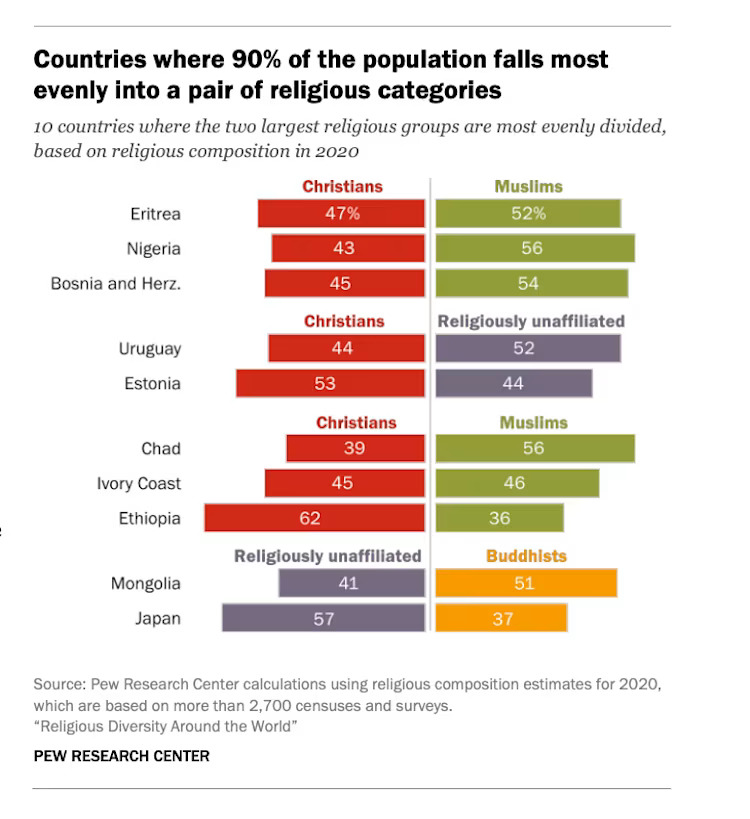
Nigeria is the second-most diverse among large nations, with the population nearly split between:
- Muslims: 56%
- Christians: 43%
Among the nine countries where 90% of the population is split between two religions, seven include Christianity among those groups.
Pakistan is the least religiously diverse among the world’s largest nations, with 97% of its population Muslim.